
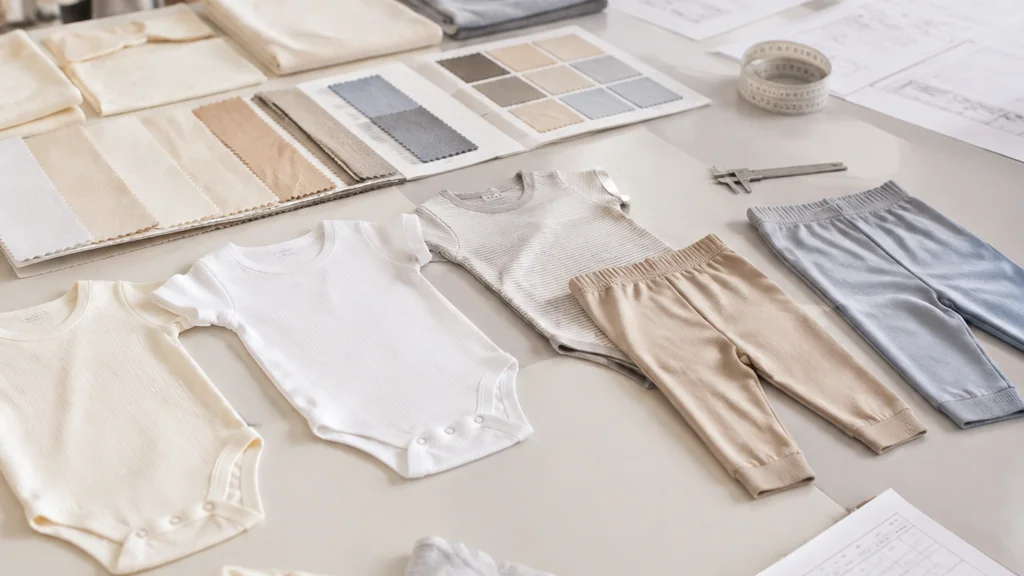
Babywear measurement tolerance after wash is not only a technical pattern issue. For private label baby and toddler clothing, it is a buyer-risk control that connects fabric shrinkage, sewing tension, pressing, wash behavior, size grading, and final quality inspection. A practical tolerance plan tells the factory which points of measurement matter most, when garments must be washed before measuring, how many pieces should be checked, and what happens when one size or color starts drifting outside the approved range.
For NEWONELINE buyers, the goal is not to chase impossible zero-variation production. The goal is to agree on realistic tolerances before bulk cutting, test them during sampling, and keep measurement records clear enough that both brand and factory can make fast decisions. When tolerance is handled early, fit comments become specific. When it is left until final inspection, teams often discover that the garment looks acceptable on the table but has already moved away from the approved size intent after washing.
Why does post-wash measurement tolerance matter for babywear?
Babywear has less room for uncontrolled variation because the garments are small, body proportions change quickly by age range, and comfort problems are more visible to parents and caregivers. A half inch that feels minor on an adult sweatshirt may noticeably affect a baby bodysuit, romper, pajama, pant, or sleep-and-play style. Length, chest width, neck opening, sleeve length, rise, thigh, cuff opening, and leg opening all influence whether the garment is easy to dress, comfortable to wear, and consistent across sizes.
Post-wash tolerance matters because many babywear fabrics are knits, ribs, fleece, gauze, terry, interlock, jersey, or blended textiles that relax differently after cutting, sewing, laundering, drying, and pressing. Some garments look stable before wash but change after the first wash cycle. Others recover in width but shorten in body length. A supplier cannot control these risks only by checking the original paper pattern. The finished garment must be measured against the approved spec under agreed conditions.
For a sourcing team, the practical question is simple: what should the garment measure when the customer receives it and uses it as intended? A production spec that only controls pre-wash measurements may not answer that question well enough.
Which measurements should a babywear brand control most closely?
Not every point of measurement carries the same risk. A brand should separate critical fit points from general construction points before sampling begins. Critical points are the measurements that affect dressing, comfort, safety-adjacent usability, or visible size consistency. General points still matter, but they may have more practical tolerance because they do not change the garment experience as strongly.
On baby bodysuits and rompers, common critical points include chest width, body length, shoulder, neck opening, sleeve length, sleeve opening, crotch depth, snap area alignment, thigh opening, and leg length. On baby pants and sets, waist relaxed, waist extended, rise, inseam, outseam, hip, thigh, ankle opening, and cuff recovery often need extra attention. For baby blankets or textile accessories, finished length, width, edge finish depth, and shape distortion can matter more than body-fit measurements.
The tolerance table should be style-specific. A stretchy rib cuff can absorb more movement than a fixed woven opening. A relaxed-fit sweatshirt may accept a wider body tolerance than a slim baby legging. A tiny newborn size often needs tighter control than a larger toddler size because the same absolute variation represents a larger percentage of the garment.

How should tolerances be written in a babywear tech pack?
A useful tech pack does more than list measurements. It tells the factory how each measurement is taken, whether the garment is measured flat or relaxed, whether elastic is stretched, whether the garment is washed before measuring, and which tolerance applies to each size. Without that detail, two inspectors can measure the same baby garment and reach different conclusions.
For example, chest width should state whether the garment is buttoned or zipped, laid flat without stretching, and measured from side seam to side seam at a defined point below the armhole. Neck opening should state whether rib trim is relaxed or gently smoothed. Waist should state both relaxed and extended measurements when elastic recovery matters. For pants, inseam and rise should be defined from consistent seam intersections. For cuffs, opening and relaxed recovery should be recorded in the same way at sample and bulk stages.
A buyer should avoid vague instructions such as “standard tolerance” or “factory tolerance.” Those phrases invite dispute because every factory, garment type, and fabric can behave differently. A stronger approach is to define realistic tolerances by measurement point and then confirm them through proto, fit, size-set, pre-production, and early bulk checks.
What should be checked before bulk cutting?
Bulk cutting should not begin until the team understands how the fabric behaves. Fabric relaxation, marker planning, shrinkage allowance, spreading tension, cutting accuracy, and bundling discipline all influence final measurement. If the fabric has not rested properly before cutting, the sewn garment may appear small or twisted after wash. If shade lots or fabric lots behave differently, one colorway can measure differently from another even when the pattern is the same.
Before bulk cutting, the factory and buyer should compare the approved fit sample, pattern, shrinkage test result, fabric lot behavior, size grading rule, and target finished measurements. The pre-production sample should confirm the final construction order, stitch tension, seam allowance, trim placement, pressing method, and wash condition if applicable. If the garment will be washed, enzyme-finished, softened, steamed, or heavily pressed, those finishing steps should be reflected in measurement approval.
For babywear, this stage is especially important for rib necklines, cuffs, elastic waistbands, zipper-front styles, snap crotches, and multi-fabric designs. Different trims and panels can pull the garment in different directions. The tolerance plan should catch those risks before fabric has been committed to a large production lot.
Post-wash tolerance checklist for babywear production
| Checkpoint | What to confirm | Why it matters |
|---|---|---|
| Measurement method | Flat, relaxed, stretched, buttoned, snapped, or zipped condition is defined for every point. | Prevents inconsistent inspector judgment. |
| Wash condition | Pre-wash and post-wash checkpoints are separated when the style requires laundering review. | Shows whether the garment remains stable after realistic handling. |
| Critical points | Chest, body length, neck opening, sleeve, rise, inseam, waist, cuff, and leg openings are ranked by fit risk. | Keeps attention on measurements that affect comfort and size consistency. |
| Size-set records | Each approved size is measured and recorded before bulk production release. | Confirms grading works beyond one sample size. |
| Color and fabric lots | Different fabric lots or colorways are checked when behavior may vary. | Reduces surprise variation between color options. |
| Corrective action | Out-of-tolerance pieces trigger root-cause review before repeating the same sewing or finishing condition. | Fixes process drift instead of only sorting defects at the end. |
How do sampling stages support tolerance control?
Each sample stage answers a different tolerance question. A proto sample checks whether the construction idea can be made. A fit sample checks whether the garment shape, measurements, and comfort direction match the brand’s intention. A size-set sample checks whether grading is balanced across the size range. A pre-production sample checks whether the final materials, trims, construction, and finishing method are ready for production. A top-of-production sample or early-line review checks whether bulk sewing is following the approved direction.
If a brand only reviews one sample size, the factory may not detect grading problems until later. Babywear grading is sensitive because size jumps are small and age ranges are close together. A shoulder width that is acceptable in one size may not scale cleanly into another. A neckline that looks comfortable in a toddler size may be too tight or too open in a smaller size. Size-set measurement records make these issues visible before bulk cutting becomes expensive to adjust.
Post-wash checks should be planned into the sample calendar. If the style uses fabric known to relax, torque, shrink, stretch, or recover differently after laundering, the sample cannot be evaluated only in its fresh-sewn state. The buyer and factory should agree whether the final approved measurement is pre-wash, post-wash, or both.

What causes measurements to drift after wash?
Measurement drift usually has more than one cause. Fabric shrinkage is the most obvious reason, but it is not the only one. Cutting tension, fabric relaxation time, differential shrinkage between body fabric and rib trim, sewing tension, seam bulk, pressing temperature, elastic behavior, thread tension, and washing conditions can all change the finished measurement.
For knit babywear, width and length may change differently. A garment may shorten but widen, or narrow around openings while the body remains acceptable. Rib trims can pull necklines or cuffs smaller. Elastic waistbands may recover too tightly or lose recovery after heat and wash. Multi-panel styles may twist if fabric grain, cutting direction, or construction balance is not controlled.
Because the causes vary, the corrective action should not be generic. If length is short across all sizes, the pattern or shrinkage allowance may need review. If one operator’s output is inconsistent, sewing method or handling may need attention. If only one colorway fails, fabric lot behavior may be the cause. If measurements fail after pressing but not after wash, finishing conditions may be distorting the garment.
How should buyers judge out-of-tolerance results?
Out-of-tolerance results should be judged against the approved spec, the measurement method, and the risk level of the affected point. A single minor variation in a non-critical point may not require the same response as repeated failures in body length, waist, neckline, or crotch depth. The decision should consider whether the issue affects comfort, dressing, size consistency, packing, appearance, or future customer complaints.
For bulk production, measurement review should include both individual results and pattern of results. If many pieces are slightly short in the same direction, the process is drifting even if some pieces remain near the limit. If failures cluster in one size, the grading or marker may need review. If failures cluster by sewing line or bundle, handling or machine settings may need correction. If failures appear after wash only, fabric and finishing controls deserve attention.
A good factory partner will not treat measurement inspection as a blame exercise. The useful response is to identify the cause, agree on the corrective action, document the change, and confirm the next samples or production pieces before continuing at speed.
What should NEWONELINE buyers prepare before sampling?
Before requesting samples, a buyer should prepare a size chart, point-of-measure diagram, target fit comments, reference sample if available, fabric direction, washing or finishing expectation, trim details, and any comfort concerns. The factory can then advise which points need tight control and which tolerances may need flexibility because of fabric behavior or construction method.
If the buyer does not have a complete tolerance table, NEWONELINE can help structure the discussion around the garment type, size range, material, construction, and intended production path. The important part is to make tolerance visible before the first sample is judged. When tolerance is hidden, every sample comment becomes subjective. When tolerance is documented, the buyer and factory can discuss real measurements instead of impressions.
For private label babywear, this also helps purchasing teams compare suppliers more fairly. A low sample price or fast first sample is not enough if the production team cannot control fit after wash. Measurement records, sample-stage discipline, and clear corrective action are stronger signs of production readiness.
FAQs
Should babywear always use very tight measurement tolerances?
No. Tolerances should be realistic for the fabric, garment type, size range, construction, and fit requirement. Babywear often needs careful control, but unrealistic tolerances can create unnecessary rejection, cost, and delays without improving the actual wearing experience.
Is post-wash measurement needed for every babywear style?
It is most important when the material, finishing method, or product use suggests that wash behavior may change fit. Knits, ribs, fleece, gauze, elastic waistbands, cuffs, and fitted baby styles usually deserve closer post-wash review than simple stable constructions.
Can AQL inspection replace measurement records?
No. Attribute-based inspection and measurement verification answer different questions. AQL can help structure final inspection sampling, but measurement control still needs approved specs, defined measuring methods, and recorded results.
What happens if one size fails measurement tolerance?
The team should check whether the issue is caused by grading, cutting, sewing, pressing, fabric lot behavior, or wash condition. The corrective action should be confirmed before the same problem spreads across more production pieces.
Work with NEWONELINE on babywear measurement control
NEWONELINE supports baby and children’s apparel brands with OEM and ODM development, private label sampling, fabric and trim coordination, measurement review, and production quality control. Share your garment type, size range, material plan, point-of-measure chart, and sample goals so the team can help turn fit expectations into a practical production tolerance plan.

